
Convection
The hottest air in a room is near the ceiling.
Gliders can rise because of “thermals” in the atmosphere.
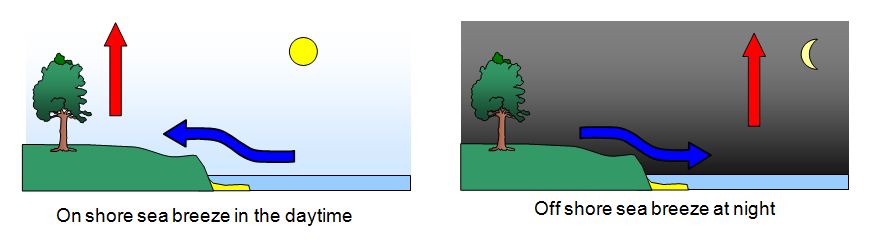
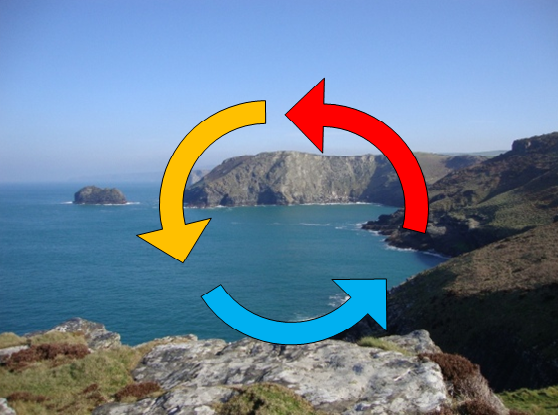
Breezes occur on the coast because of air rising above the land or sea.
The outlet for the hot water is at the top of the hot water tank.
The ice box is always at the top of a fridge.
Motor cycle engines are air cooled and are fitted with fins.
The element in a kettle is near the bottom of the kettle.
Some hot water cylinders have two immersion heaters, one small one near the top of the tank and one large one nearer the bottom.

These facts are examples of the transfer of heat by convection.
Unlike conduction, in convection it is the material itself that moves, therefore you can't have
convection in a solid.
In liquids and gases convection takes place because the
hotter, low-density fluid rises taking the heat energy with it - this is called a convection
current. The bigger the surface area of an object the more air can move round it in
convection currents and the faster it will cool. Think of the motorbike cooling fins.
In the photograph the candle flames are bending inwards. This
is because there is an updraft of air at the centre and this is drawing in cold air from the
sides pushing the flames towards the centre.
You can demonstrate convection by
the following simple experiments.
Experiments


1. Convection in water
Fill a beaker with cold water and then carefully
drop a few crystals of potassium permanganate into it so that they fall close to one side of
the beaker. Now heat the base of the beaker just under where the crystals have
fallen.
You should see the colour rise up this side, go across the top and then fall down
the other side of the beaker — this is a convection current.
You can also use the
special piece of apparatus shown in the diagram. It is a "square " glass tube filled with water.
Drop a crystal of potassium permanganate into the top and then heat one of the bottom
corners gently. You will see the colour begin to move round the tube going down the limb
opposite the heating and then rising up the other side above the Bunsen due to convection
currents in the water.

2. Convection in air
(a) simply hold your
hand above the bunsen flame. You can easily feel the hot air rising.(b) Use the apparatus shown in the diagram. Light the candle and then
hold a piece of smouldering paper or string over the top of the other chimney.
The
smoke should be pulled down that chimney and rise up the other chimney with the hot air
above the candle.
3. Make a small rotor out of aluminium foil and
hold it above a bunsen burner to test the effect of the convection currents in the
air.
What is actually is convection?
Convection occurs because the air (or other fluid) is heated, expands, becomes
less dense and so rises through the more dense colder air
Land and sea
breezes
In the daytime the land heats up quickly, the air above it rises and cool air
is drawn in from the sea.
At nighttime the land cools quickly while the sea stays
warm. Air rises above the sea and a breeze blows off the coast onto the sea.
Problems
1. Why is it not vital to keep the lid of a chest freezer closed?
2. Why is the ice box always at the top of the fridge?
3. Why do you think that convection is important in a house hot water system?
4. Why does a coal, fire help to ventilate a room as well as heat it?
A VERSION IN WORD IS AVAILABLE ON THE SCHOOLPHYSICS USB