Stars and constellations
Perseus, Andromeda, Pegasus and
Cassiopeia
If you look at the sky at about 11 pm in October then you will
see the stars in this map.
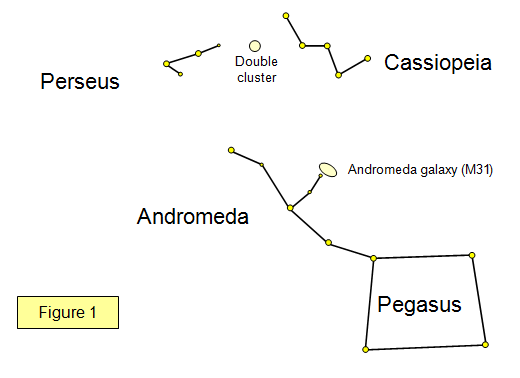
The Milky Way goes through Perseus and
Cassiopeia and a telescope will show you thousands of faint stars there. Some of them are
grouped in clusters and a well-known cluster is called the Double Cluster because it is really
two clusters of stars close together. It's worth looking at with a telescope.
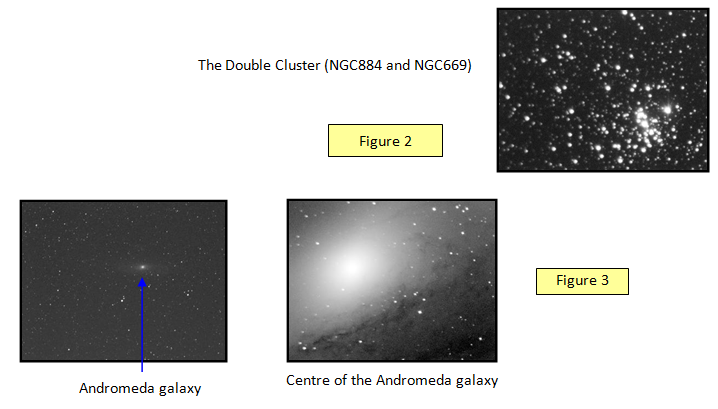
The Andromeda Nebula is the only
galaxy that you can see without a telescope. On a clear night with no Moon you can just see
it as a faint fuzzy patch, but it is really a huge number of stars about two MILLION light years
away.
Orion and
Taurus
If you look at the night sky at about 11 pm in early January then you will
see these stars to the south. You can't miss them because Orion is a very obvious group and
Sirius is the brightest star that can be seen in the northern sky.
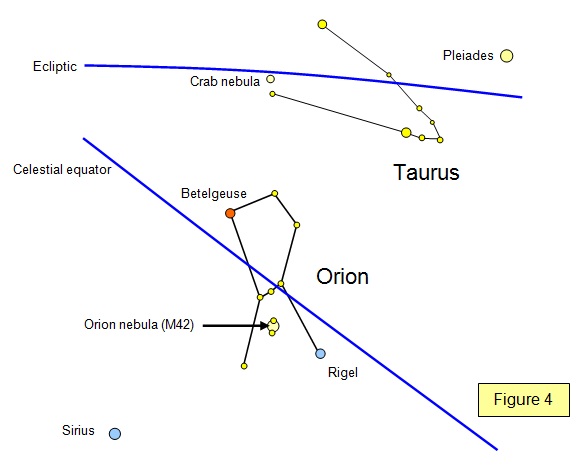
There are three other important things to be seen.
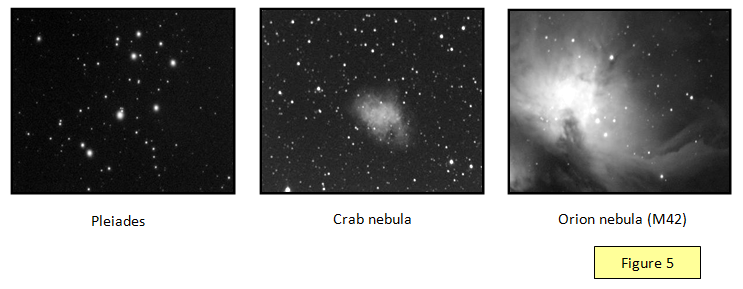
1. The
Pleiades is a small but bright cluster of stars that look very good in binoculars.
2. The
Crab nebula can't be seen without a telescope, but it is the remains of a huge explosion
when a star blew itself to pieces nearly a thousand years ago.
3. The Orion nebula can
just be seen in the country on a clear night as a tiny fuzzy patch in Orion's dagger and is
really good if you use a telescope. It is a huge cloud of gas that is glowing by reflected light
from the nearby stars.
The following three photographs show how these objects
appear when observed with my 12" reflecting telescope. (Figure 5)
Into deep space
Imagine that we
could now leave the Solar System and actually take a journey out into deep space. The
Universe is so vast that the best way of appreciating the scale of distances is to think about
this in terms of the time it takes light to travel those distances.
Imagine now that you
could travel as fast as light, that is 300,000 km a SECOND, it would still take you just over a
minutes to get to the Sun and 4.3 years to get to the nearest star.
We call the
distance that light can travel in a year a LIGHT YEAR. It is a very long way, about
9,000,000,000,000 km (6 million million miles).
The nearest star is over 4.3 light
years away and the star Vega is 25.5 light years away!
So unless we can find another
way of travelling we will never be able to reach the stars.
The following table shows
you some important distances in the Universe.
| Object |
Distance at light speed |
| Moon to the Earth |
1.25 s |
| Sun to the Earth |
8.3 min |
| Jupiter (minimum) |
35 min |
| Nearest star to the Earth |
4.2 min |
| Sirius to the Earth |
8.6 years |
| Diameter of our galaxy |
100 000 years |
| Andromeda galxy to the Earth |
2 300 000 years |
| Virgo galactic cluster to the Earth |
65 million years |
| Radius of the observable Universe |
13 700 million years |
The stars
What is a star? The first thing to remember is that the Sun is
a star and quite an ordinary one at that. The only reason that it looks so bright is that is so
close to us – the next nearest star is more than 250 000 times further away. We now know
that the Sun is just an average sort of star. It only looks bright because it is much closer to us
then any of the others. It is actually a huge ball of gas nearly a million miles (1.5 million km)
across and about 93 million miles (150 million km) from the Earth.
A star is really a
huge cloud of very hot gas that gives out a lot of energy. It keeps shining by the energy
released from nuclear fusion reactions in its core. The 'gas' in the middle has a 'squashed' to
a very high density due to the enormous forces of pressure and gravitational attraction
The surfaces of some stars are fairly cool (about 2000 oC) while others
are very hot like Rigel (nearly 30,000 oC). The Sun is quite average – around 6000
oC at the surface. All the stars are much hotter in the middle of the core (over 2
million degrees) where the fusion reactions are producing energy.
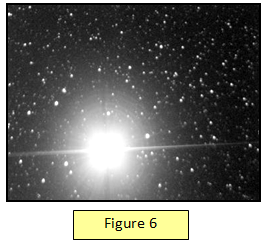
The bright star in Figure 6 is Altair in the constellation of
Aquila. It has a surface temperature of about 8500
oC and is ten times as bright as
the Sun. The reason it looks so much fainter is because it is 16.6 light years away from
us.
Some stars are no bigger than the Earth but some are so vast that it would take
200 years to fly once round them in our supersonic jet!
Variable
Stars
Other stars don't shine steadily like the Sun. They wink on and off rather like
a lighthouse, these stars are called Variable Stars.
You wont really notice stars
doing this if you look at the sky; you really need to watch them very carefully from night to
night.
Astronomers use these variable stars a lot, they can tell us a lot about the
stars and how far away they are. An important variable star that is used to help measure
distance is Delta Cephei.
Double Stars
Some stars are Double, that
means there are two stars very close to each other, they go round and round each other like
two people dancing.
Exploding Stars
Sometimes the nuclear furnace
that powers a star gets out of control. When this happens the star blows up.
Now a star
is a huge thing and so when it blows up you get a huge explosion. In fact it makes the star so
bright that you can sometimes see it in daylight.
This is what happened in 1054
when the Chinese saw what they thought was a new star, it was really one that had got much
brighter because it had blown up.
This explosion was so vast that we can still see the remains of it today.
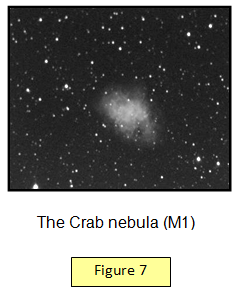
The huge cloud of gas that it produced is still expanding and it is called the Crab
Nebula.
The picture shows the Crab Nebula taken through my 12" reflector, and the
position of the nebula is marked on the map on page 2.
Astronomers call these
exploding stars a NOVA, or if the explosion is even bigger a SUPERNOVA. Don't expect to
see one in the sky, they don't happen very often, and sometimes the explosion is not big
enough for us to see from the Earth.
A VERSION IN WORD IS AVAILABLE ON THE SCHOOLPHYSICS USB