Volts, amps and joules
The voltmeter
As you have seen, voltage is a measure of electrical energy;
its proper name is potential difference.
The voltage between two points on a circuit is called the potential difference between those two points.

The voltmeter is therefore connected in parallel
with the bulb as you see in the circuit diagram (Figure 1), it measures the difference in the
energy of the electricity between points A and B, that is before and after it has passed
through the bulb.
At A the electricity has a lot of energy but at B most of this energy
has been changed into heat and light in the bulb.
Current and voltage
It is often
easy to confuse current with voltage and so it is a good idea to remember the following:
Current is the rate of flow of charge through a wire.
Voltage is a measure of the energy of that charge.
It is therefore possible to
have two wires carrying the same current but one with much more energy than the
other.
The two circuits in Figure 2 explain this.
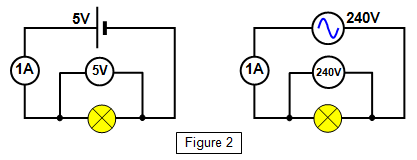
The low voltage bulb has a current of 1 A flowing
through it, it runs on 5 V and gives out energy as heat and light.
However the mains
bulb runs on 240 V and also has a current of 1 A flowing through it. It gives out a lot more
energy and so is much brighter.
The amount of electricity passing through each
bulb per second (the current) is the same, but the electric charges passing through one bulb
have more energy than those passing through the other
one.
The volt
Energy is measured in
joules and so we need to know the connection between volts and joules.
The potential difference (p.d.) between two points in a circuit is 1 V if 1 joule of electrical energy is changed to other forms of energy when 1 C passes from one point to the other.
In other words if the potential
difference between two points is 12 V then every coulomb of electricity passing from one
point to the other loses 12 J of energy.
If we think about the input of energy, then a 240
V supply will give each coulomb 240 J of energy while a 5 V supply only gives each coulomb
5 J.
Example problems
1. Find the energy lost by 6C passing through 4V Energy = 6 x 4 = 24 J
2. What energy is given to 3C by a 3 V cell. Energy = 3 x 3 = 9 J
We can write these
ideas in a formula as:
Energy = joules = volts x charge = voltage x current x time
joules= volts x coulombs
volts = joules per coulomb
These mathematical examples clearly explain
the results with the two bulbs.
Another way of thinking about energy is the length of
time that a certain battery will supply a certain amount of current. This is usually written in
Ampere hours (Ah).
Energy capacity of a battery

If a battery is labelled 12V 48 Ah it means that it can supply
48A for 1 hour at 12V, or 24 A for 2 hours at 12V or 1 A for 48 hours at 12V and so
on.
The energy stored in a 12V 48 Ah battery is = 12x48x3600 = 2.074
MJ
The energy stored in a 6V 48 Ah battery would be half that = 6x48x3600 = 1.037
MJ
A car battery will have a capacity of between 30 and 50 Ah while a AAA torch
battery is usually around 700mAh
The photograph shows two car batteries, the
larger one has a capacity of 32 Ah while the smaller one is 16
Ah.
Problems
Copy and complete the following
table:
| 10 |
Voltage |
Charge |
Current |
Time |
Energy |
| 1 |
12V |
space |
2 A |
20s |
space |
| 2 |
2V |
space |
3 A |
2 min |
space |
| 3 |
6V |
space |
2 A |
space |
240 J |
| 4 |
20V |
space |
100 mA |
½ hour |
space |
| 5 |
100 mV |
200 C |
space |
20s |
space |
| 6 |
space |
space |
2A |
60 s |
600 J |
| 7 |
space |
20 C |
space |
5 s |
10 kJ |
| 8 |
1000V |
space |
0.5 kA |
10 s |
space |
| 9 |
2 kV |
120 C |
space |
2 ms |
space |
| 10 |
space |
150 C |
space |
7.5 s |
20 kJ |
A VERSION IN WORD IS AVAILABLE ON THE SCHOOLPHYSICS USB